Showing posts with label easy maths. Show all posts

ALGEBRA FRACTIONS


The term Algebra is derived from these two words; Alphabet and Numbers. It is a combination of both Alphabet (letters) and Numbers.
Therefore, we can say that Alphabet + Numbers = Algebra and Hence Alphabet + Numbers + Fractions = Algebra Fractions.

Types of Algebra Fraction
There are two types of Algebra fractions;
1. Monomial Fractions; These are fractions with only one value as denominator. Examples are; 
, etc…

2. Binomial Fractions; These are fractions with two values as denominator. Examples are;


, etc…

Rules for Solving Algebra Fractions
1. If the values are three digits, you factorise both numerator and denominator.
2. If the values are two digits, you look for their common factors.
3. If the values are single digit, just go ahead and simplify as there’s no need to factorise or look for common factors!

Types of Algebra Fractions

1. Simplification of Algebra Fractions
2. Multiplication & Division of Algebra Fractions
3. Substitution in Algebra Fractions
4. Equations in Algebra Fractions


1. Simplification of Algebra Fractions
Examples; Simplify the following Algebra;


Solution


Step 1

Note;
The example above contains three digit values, am I right? So we will factorise both the numerator and denominator before simplification;
NUMERATOR
a2 - 5a + 6                +6a2 (×)    (-3a & -2a)
                                   -5a (+)
a2 – 3a – 2a + 6
a(a – 3) -2(a – 3)
(a – 3) (a – 2)

Step 2

DENOMINATOR
2 – 3a + a2 (Rearrange)
a2 – 3a + 2               +2a2 (x)     (-2a & -1a)
                                   -3a (+)
a2 – 2a – 1a + 2
a (a – 2) -1(a – 2)
(a – 2)(a – 1)

Step 3

Bring the Numerator and Denominator together;


Step 4

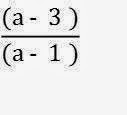
Cancellation Process; (a – 2) cancels (a – 2);


Step 1

The example 2 above contains two digit values, so we will look for common factors for both the Numerator and Denominator as well.
NUMERATOR;
6m2u2 - 4mu3 ---The common factor is 2mu2.
2mu2(3m – 2u)

Step 2

DENOMINATOR;
9m3u – 4mu3 ---The common factor is mu.
mu (9m2 – 4u2) ….this can also be written thus as 32 gives 9 and 22 gives 4;
mu (32m2 – 22u2)
mu (3m – 2u)2 ….the “raise to power 2” has been brought out as the common factor;
mu (3m – 2u)(3m + 2u)

Step 3

Combining the Numerator and Denominator;

Step 4
Cancellation Process; mu goes in 2mu2 to give 2u while (3m – 2u) cancels each other;


Step 1
This is a three digit value, remember you factorise when dealing with three digit values;
NUMERATOR;
a2 + ax – 6x2         -6a2x2 (×)    (+3ax & - 2ax)
                                       +ax (+)
a2 + 3ax – 2ax – 6x2
a(a + 3x) – 2x(a + 3x)
(a + 3x)(a – 2x)

Step 2
DENOMINATOR;
2x2 + ax – a2  (Rearrange)
- a2 + ax + 2x2       -2a2x2 (×)    (+2ax & - 1ax)
                                       +ax (+)
- a2 + 2ax – 1ax + 2x2
-a(a – 2x) – x(a – 2x)
(a – 2x)(-a – x)

Step 3
Combining the Numerator and Denominator;


Step 4
Cancellation Process; (a - 2x) cancels each other;

Note; The minus sign was brought out as a common factor;


Note; The minus sign went up! This is a rule as minus sign must always remain with the numerator;


Step 1
NUMERATOR;
ab + ac  ----the common factor will be a;

a(b + c)

Step 2
DENOMINATOR;
ad + ae   -----the common factor here will also be a;

a(d + e)

Step 3
Combining the Numerator and Denominator;


Step 4
Cancellation Process; a cancels each other;


Step 1
Note; The values above are single digit, so there’s no need for factorization or common factors. Just go ahead and simplify!

 Step 2
Cancellation Process; 2 goes in 8 gives 4 and 2 goes in 10 gives 5 while x goes in x2 gives x and z cancels z;


Series


A Series is the addition of successive terms in such a way that they are related to another according to a well defined rule. In other words, series is the addition of a sequence.

Examples of series are;
2 + 5 + 8 + 11 + 14 + ……..
4 + 16 + 64 + 256 + 1024 + ………
-1 + 0 + 7 + 14 + 23 + 34 + ……..

Note
Just like sequence you will be given what you’ll know as nth term formula to find the terms of series and the formula always differ per questions.

Examples;
1. Find the series of the first six terms of 2n + 4n2.

Solution

Note
2n + 4n2 stands as a formula that you’ll use to solve for the first six terms mentioned in the question. Finding the first six terms means solving for T1, T2, T3, T4, T5 and T6 respectively.

Step 1
Tn = 2n + 4n2 ---The nth term formula.
T1 = 21 + 4(1)2
T1 = 2 + 4(12)
T1 = 2 + 4(1)
T1 = 2 + 4
T1 = 6

Step 2
T2 = 22 + 4(2)2
T2 = 4 + 4(22)
T2 = 4 + 4(2 × 2)
T2 = 4 + 4(4)
T2 = 4 + 4 × 4
T2 = 4 + 16
T2 = 20

Step 3
T3 = 23 + 4(3)2
T3 = 8 + 4(32)
T3 = 8 + 4(3 × 3)
T3 = 8 + 4(9)
T3 = 8 + 36
T3 = 44

Step 4
T4 = 24 + 4(4)2
T4 = 16 + 4(42)
T4 = 16 + 4(4 × 4)
T4 = 16 + 4(16)
T4 = 16 + 64
T4 = 80

Step 5
T5 = 25 + 4(5)2
T5 = 32 + 4(52)
T5 = 32 + 4(5 × 5)
T5 = 32 + 4(25)
T5 = 32 + 100
T5 = 132

Step 6
T6 = 26 + 4(6)2
T6 = 64 + 4(62)
T6 = 64 + 4(6 × 6)
T6 = 64 + 4(36)
T6 = 64 + 144
T6 = 208

 The series of the first six terms will be; 6 + 20 + 44 + 80 + 132 + 208 +…


2. Find the sum of the series n2 + 5n up to the 4th term.

Solution

Step 1
Tn = n2 + 5n---Formula
T1 = 12 + 5(1)
T1 = 1 + 5
T1 = 6

Step 2
T2 = 22 + 5(2)
T2 = 4 + 5 × 2
T2 = 4 + 10
T2 = 14

Step 3
T3 = 32 + 5(3)
T3 = 9 + 5 × 3
T3 = 9 + 15
T3 = 24

Step 4
T4 = 42 + 5(4)
T4 = 16 + 5 × 4
T4 = 16 + 20
T4 = 36

 The sum of the series will be; 6 + 14 + 24 + 36 = 80.


Practice these questions below;
1. What is the sum of the eight series of an nth term equals 2n + 5n?
2. Find the seven series of the term (n + 1)2 – 2n.
3. Write out the series of the term 3n(n – 1).
4. Find the series of the first five terms of n(2 + 3n).
5. Find the sum of the series 5(3n - 1) up to the 4th term.

Linear Inequalities


An inequality is just like linear equation which has two sides and an unknown variable which are always represented with alphabets (a-z) but deals with a lot of signs.
Signs of inequalities
> Greater than
< Less than
≥ Greater or equal to
≤ Less than or equal to

Solve the following inequalities;

Example 1; Simplify 2x – 4 > 8

Solution

Note;
In order to do this, you must consider the two sides of this inequality.


2x – 4 > 8 (Make x the subject of the equation)

2x > 8 + 4

2x > 12 (Divide both sides by 2)

x > 6.

Example 2; Solve the inequalities 3x – 8 ≤ 10 + 5x

Solution

3x – 8 ≤ 10 + 5x (Collect like terms)

3x – 5x ≤ 10 + 8

- 2x ≤ 18 (Divide both sides by the co-efficient of x which is -2)

x ≥ - 9.

Note; the inequality sign must change when dividing with a minus sign).


Practice these questions below;
1. Simplify 4x – 1/3     2/3x + 2


3. Simplify 6x – 2 < 2x + 8
4. Simplify 1/3y  >  1/2y  +  1/4
5. Simplify 6/x    2